
High-quality warehouse shed construction is essential for businesses operating across Islamabad and Rawalpindi—Pakistan’s most strategically located industrial region. Strategically located at the junction of the Motorway network, Grand Trunk Road, and the Karakoram Highway corridor. The Twin Cities directly connect northern Pakistan’s manufacturing base to Lahore, Karachi, and KPK.
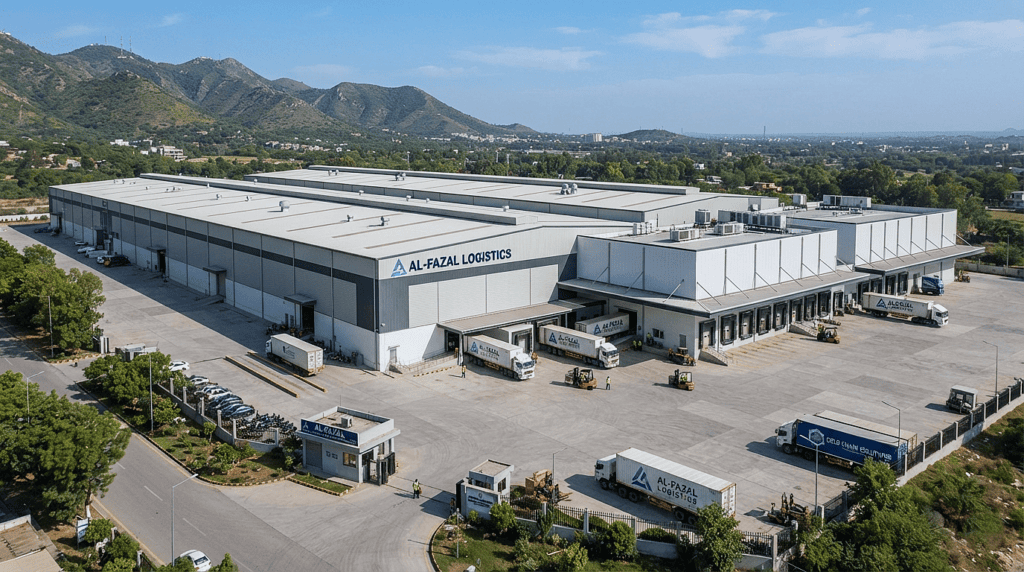
For factory owners, logistics companies, pharmaceutical operators, and food processors in this region, the construction challenge is distinct. Islamabad’s CDA and Rawalpindi’s RDA both enforce stricter documentation and approval requirements than most other Pakistani cities. Islamabad’s colder winters require better thermal insulation than Punjab’s warmer cities. And the Twin Cities’ growing pharmaceutical and food processing sector creates strong demand for cold storage steel sheds. Built to HACCP and food-safety standards — a specialized requirement that generic industrial shed suppliers are not equipped to meet.
Steel City designs and delivers warehouse sheds for Rawat and Hattar. PEB structures for Rawalpindi’s industrial zones, and fully specified cold storage steel sheds for Islamabad’s food, pharma, and logistics operators . With complete CDA and RDA documentation as standard.
The Twin Cities Industrial Landscape — What Makes It Different
Planning for warehouse shed construction across the Twin Cities industrial market requires recognizing three factors. That do not apply in the same combination anywhere else in Pakistan.
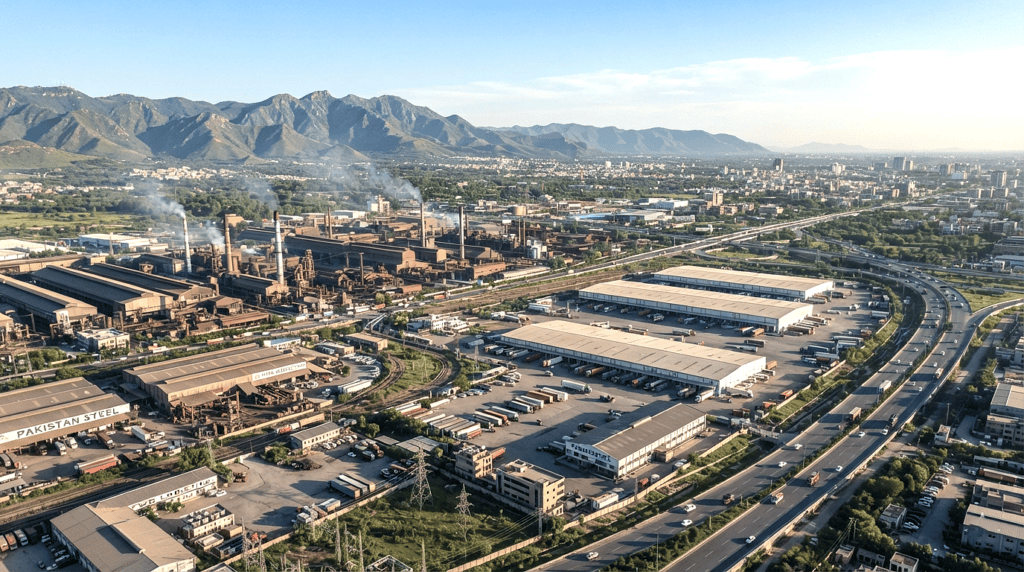
Higher regulatory standards: The Capital Development Authority (CDA) in Islamabad and the Rawalpindi Development Authority (RDA) both require stamped structural engineering drawings, material specifications, and NOC clearances before contractors can erect any permanent industrial structure. The documentation burden is significantly higher than in most Punjab cities, and non-compliant structures face demolition risk. Every Steel City project in the Twin Cities comes with full CDA and RDA compliant documentation as part of the standard project package.
A colder winter profile: Islamabad’s temperatures fall to 2°C to 5°C in January, and locations north of the city . Including parts of Rawalpindi Cantt and the Murree Road corridor — see lower temperatures still. For any heated production facility, pharmaceutical cold chain, or food storage warehouse in Islamabad. Building envelope insulation is not optional — it determines whether your refrigeration. HVAC system can maintain specified conditions during winter without excessive energy consumption.
A mature pharmaceutical and food processing sector:Islamabad and Rawalpindi house numerous pharmaceutical manufacturers and medical supply companies. The region also supports major food processors and cold chain logistics operators. This industrial cluster drives high demand for specialized, temperature-controlled storage sheds. These facilities must meet strict international food safety and pharmaceutical storage standards. However, generic steel shed suppliers lack the specialized engineering expertise to serve these needs reliably.
Warehouse Shed Construction in Rawat — Rawalpindi’s Industrial Growth Zone
Warehouse shed construction in Rawat has accelerated rapidly in recent years. The expanding Rawat Industrial Estate accommodates logistics operators, light manufacturers, and storage businesses. These enterprises actively serve both Rawalpindi and Islamabad. Geographically, Rawat sits on the N-5 National Highway east of Rawalpindi. This prime location offers direct road links to Lahore and Islamabad’s commercial districts. Consequently, Rawat remains one of the region’s most sought-after industrial hubs.
Rawat Industrial Estate — Shed Specifications and Demand Profile
Rawat Industrial Estate hosts a diverse mix of manufacturing, assembly, and storage operations. Active warehouse listings in the estate feature units ranging from 2 to 6 kanal. This range confirms that the site serves both small and large-scale industrial operators. For new construction, clients commonly specify single-span PEB structures. These builds typically feature clear widths between 20 and 40 meters. Floor-to-eave heights reach 5 to 8 meters to accommodate high-density racking and handling equipment. Additionally, facilities include covered truck loading bays with reinforced aprons for heavy vehicles.
Our warehouse shed construction in Rawat is engineered with the estate’s specific ground conditions in mind, utilizing reinforced concrete pad foundations. Rawalpindi’s soil profile features clay-bearing strata that demand specialized foundation engineering — meaning standard anchor bolt systems are rarely sufficient.
Accordingly, Steel City executes a site-specific foundation design for every Rawat project based on plot-level soil assessments, thereby protecting clients from the severe settlement issues that routinely plague under-engineered structures across the estate.
Hattar Industrial Estate — KPK’s Gateway to Twin Cities Logistics
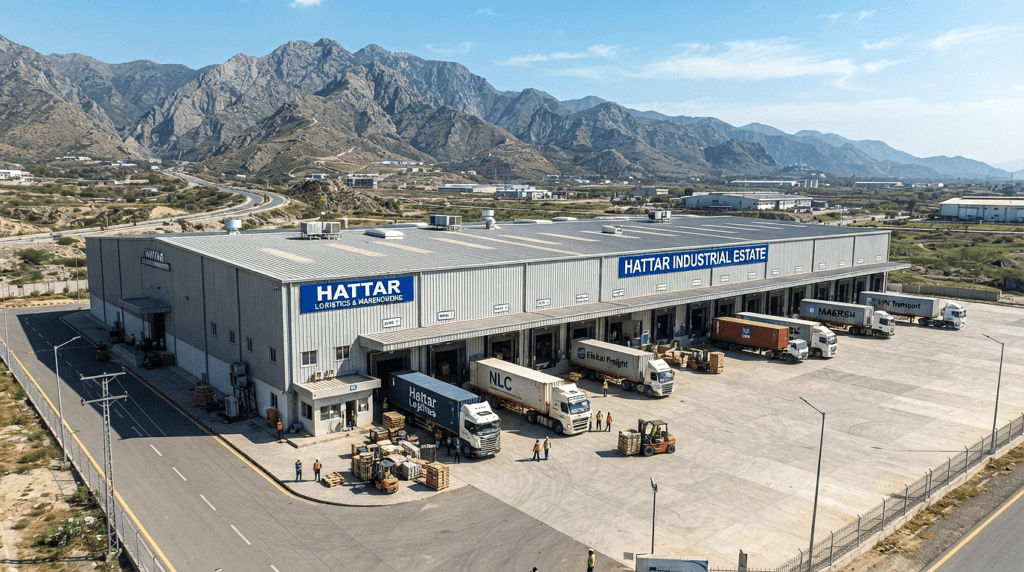
Hattar Industrial Estate sits approximately 60 kilometres from Islamabad on KPK’s Haripur Road. The hub functions as a vital extension of the Twin Cities’ industrial capacity. Specifically, the estate hosts textile, food processing, chemical, and light engineering facilities. These companies access Twin Cities markets directly through the Motorway and National Highway network.
Multiple commercial demands drive local warehouse shed construction. Manufacturers require extra storage, while logistics providers consolidate cargo before onward distribution. Additionally, new industrial entrants establish greenfield operations across this highly accessible zone.
Hattar projects require specific delivery and installation considerations. While road access from Islamabad is straightforward, terrain conditions vary across the estate. Certain plots demand more extensive site preparation than standard, flat Punjab sites. Consequently, Steel City engineers site-specific foundation designs tailored to each plot’s unique ground conditions. Additionally, the team executes comprehensive logistics planning to transport heavy steel components directly to the estate.
PEB Structure Manufacturers Rawalpindi — Engineering for the Twin Cities Market
I
Industrial growth in Rawalpindi drives surging demand for warehouse shed construction. This expansion demands specialized PEB engineering tailored to regional commercial needs. Local PEB manufacturers serve factory owners, logistics firms, housing developers, and government agencies. Furthermore, each client group enforces distinct documentation requirements, tight timelines, and rigorous quality standards.
PEB Steel Fabrication for Rawalpindi’s Industrial Zones
Rawalpindi’s prime industrial zones include the I-9 and I-10 sectors along the Islamabad border. Other major hubs include the Adiala Road corridor and estates bordering the Islamabad Expressway. However, each industrial area presents distinct site access conditions and local regulatory requirements. Accordingly, Steel City engineers site-specific designs for every PEB factory and warehouse shed. The team actively customizes structures based on plot dimensions, orientation, and utility connections.
Standard PEB structures in Rawalpindi feature high-tensile steel frames with galvanized or primer-coated finishes. Additionally, all occupied facilities include EPS-insulated roof panels for enhanced thermal performance. These builds also incorporate complete electrical packages with distribution boards, lighting, and power outlets.
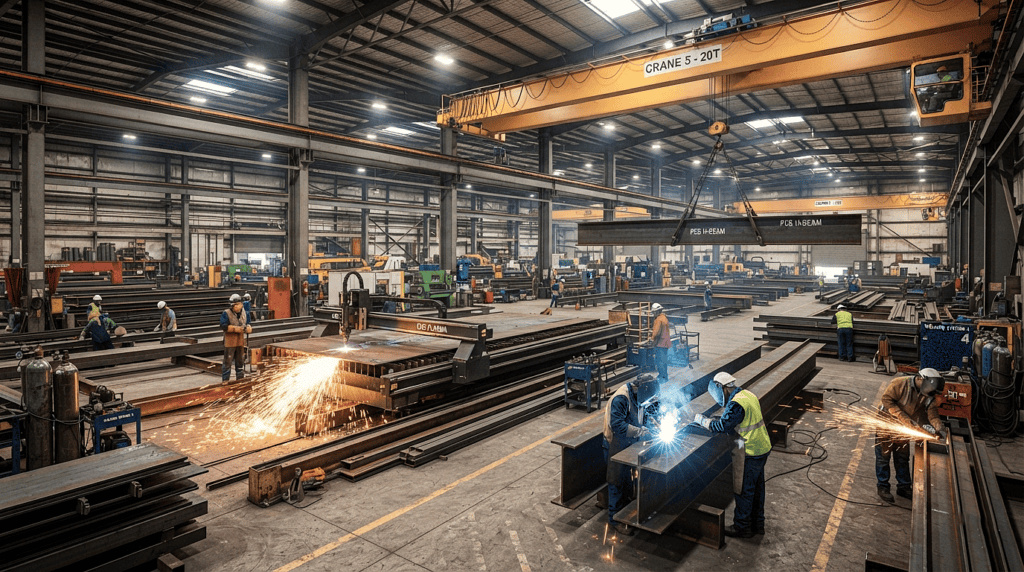
For heavy industrial applications, Steel City integrates crane runway beams directly into the primary framework. This upfront engineering eliminates costly future modifications to the existing steel structure.
CDA and RDA Documentation — A Non-Negotiable for Islamabad and Rawalpindi
One of the most common and costly mistakes made by PEB buyers in the Twin Cities is engaging a supplier who does not have the in-house engineering capability to produce CDA and RDA compliant structural documentation. Without stamped drawings from a PEC-registered engineer, a structure cannot legally be erected in Islamabad or Rawalpindi. Structures built without documentation face enforcement action, including stop-work orders and demolition notices.
Steel City provides a comprehensive documentation package with every Twin Cities PEB project. This package includes structural calculation reports and PEC-stamped engineering drawings. Additionally, clients receive primary steel material test certificates and final as-built drawings.
The team also prepares and manages formal submissions for CDA and RDA approvals. Extensive municipal experience enables engineers to navigate these local authority processes efficiently. Explore our complete technical guide to learn more about PEB structures and fabrication across Pakistan. PEB Structures in Pakistan: Industrial Steel Sheds, Warehouse Construction & Multi-Span Workshops
Industrial Steel Sheds in Islamabad — CDA Compliance and Cold-Weather Engineering
Industrial warehouse shed construction in Islamabad must satisfy two strict requirements: full CDA documentation compliance and cold-weather thermal performance. full CDA structural compliance documentation, and engineering for a climate that includes cold winters demanding meaningfully better building envelope thermal performance.
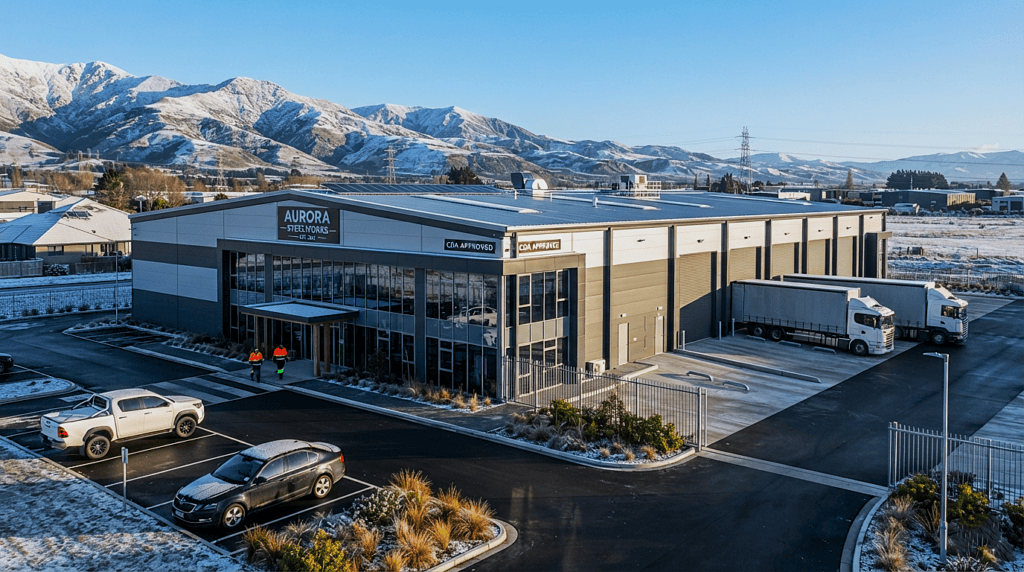
Steel City’s Islamabad projects are designed with PU-insulated roof and wall panels as standard — not EPS panels used in warmer Punjab cities. The higher thermal resistance of PU insulation keeps interior temperatures stable through Islamabad’s winter months without placing excessive load on heating systems, and during summer keeps factory and warehouse interiors at manageable temperatures despite the heat of the Potohar Plateau. All Islamabad projects include full CDA compliance documentation and the team manages all authority submissions in-house.
Market data confirms that Islamabad’s construction costs run higher than Lahore’s — labour and material availability in the capital carries a premium. Steel City mitigates this for clients by fabricating all structural steel components at the Lahore production facility and delivering to Islamabad, keeping fabrication quality and cost within the standard project pricing framework while providing on-the-ground installation teams for site work.
Cold Storage Steel Sheds — Purpose-Built for Islamabad’s Pharma and Food Sector
Islamabad and Rawalpindi host a significant concentration of pharmaceutical manufacturers, medical distributors, food processors, and cold chain logistics operators. These businesses require cold storage steel sheds that provide more than simple insulation — they need purpose-engineered facilities that meet HACCP food safety standards, pharmaceutical storage regulations, and the specific temperature and humidity requirements of each client’s products.
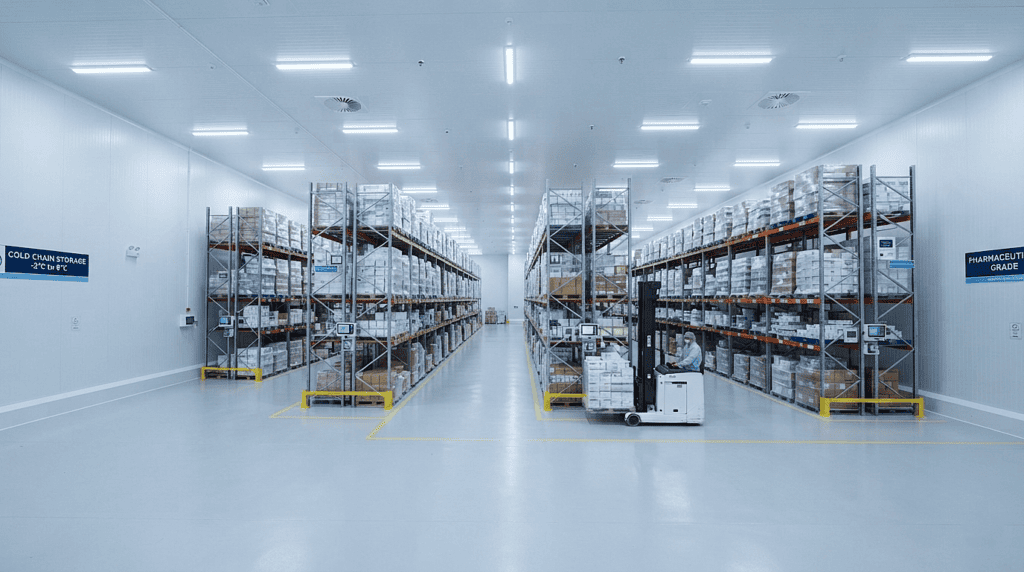
A poorly specified cold storage steel shed is an expensive mistake.Industry research confirms that the most common cold storage specification error in Pakistan is choosing 75mm PUF panels over 100mm to reduce upfront capital costs. Consequently, within just 18 months, the thinner panels’ inadequate thermal resistance drives refrigeration energy and compressor maintenance costs that far exceed the initial savings.
To prevent this costly mistake, Steel City’s engineering team sizes insulation panels based on rigorous thermal calculations for each project’s operating temperatures, ambient conditions, and product loads — rather than cutting upfront material specs.
PUF and PIR Insulation — Choosing the Right Panel for Your Cold Storage
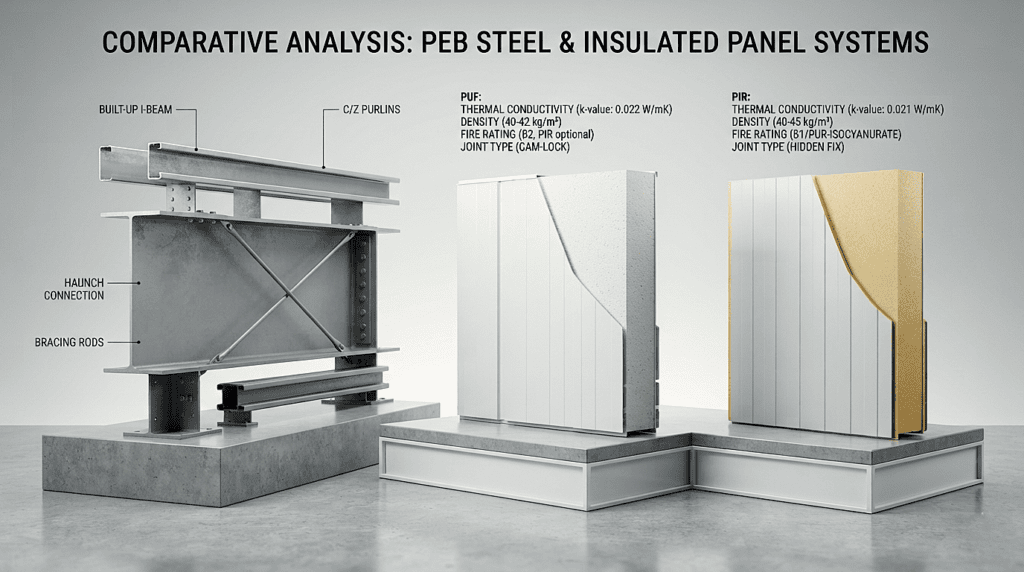
PUF (Polyurethane Foam) is the industry standard insulation core for cold storage steel sheds in Pakistan. It delivers the lowest thermal conductivity of any widely available insulation material — typically 0.022 to 0.028 W/mK — allowing the required thermal resistance to be achieved in a thinner panel than any alternative. PUF panels are available in 75mm, 100mm, and 150mm thicknesses, with the correct specification determined by the interior design temperature: ambient cool storage (+15°C to +5°C) uses 100mm; chilled food storage (+5°C to 0°C) uses 100 to 120mm; frozen storage (0°C to -18°C) and deep-freeze (-18°C to -40°C) require 150mm panels.
PIR (Polyisocyanurate) panels deliver superior fire resistance compared to standard PUF. For pharmaceutical cold stores, food processing facilities, and any application where fire safety regulations require non-combustible or fire-rated building materials, PIR panels are the correct specification. Standard PUF panels should not be specified for pharmaceutical manufacturing or food processing environments where regulatory fire ratings apply — the correct specification is PIR panels or fire-rated PUF assemblies with Rockwool at fire compartment boundaries.
Joint Sealing — As Important as the Panel Specification
A cold storage steel shed can be specified with the correct panel thickness and still fail within two to three years if the panel joints, penetrations, and door seals are not installed correctly. Moisture migrates from warm exterior air toward the cold interior through any unsealed joint, panel edge penetration, or poorly hung door. Within two to three years of a poorly sealed installation, moisture accumulates in panel edges and thermal performance degrades to the point where refrigeration systems cannot maintain specified temperatures without overrunning.
Steel City’s cold storage installation teams seal all panel joints with cold-room-grade vapour barrier tape and closed-cell foam backer rod at all penetrations — not general-purpose silicone. All pipe penetrations for refrigerant lines, electrical conduit, and drainage are sealed with cold-room-specific materials before insulation cladding is applied. Every door installation is commissioned with verified seal integrity before handover.
HACCP-Compliant Food Storage Sheds
For food processors, cold chain operators, and food storage businesses in Islamabad and Rawalpindi, HACCP compliance is not optional — the Pakistan Standards and Quality Control Authority (PSQCA) and the procurement standards of major food retailers and export buyers require it.
To meet these rigorous standards, Steel City engineers its food-grade cold storage sheds with hygienic wall and ceiling finishes, sloped floors with stainless steel drain channels, washdown-resistant door systems, and positive-pressure HVAC configurations that maintain clean-room interior conditions.
Pharmaceutical Cold Storage — GDP-Compliant Temperature Control
Pakistan’s Drug Regulatory Authority (DRAP) guidelines require pharmaceutical wholesalers, hospital medical stores, and manufacturers in Islamabad and Rawalpindi to store medicines within specified temperature ranges under Good Distribution Practice (GDP) standards.
To meet these strict requirements, a pharmaceutical cold storage facility demands far more than basic insulated walls and refrigeration; it relies on continuous temperature monitoring, validated thermal mapping, dedicated backup power systems, and automated threshold alarms. Accordingly, Steel City engineers every pharmaceutical cold storage shed with these features as standard, while also providing complete commissioning documentation ready for DRAP audit approval..
Material Comparison for Warehouse and Cold Storage Sheds — Twin Cities 2026
The table below covers the four main construction approaches for industrial and storage sheds in the Islamabad and Rawalpindi market, with Twin Cities-specific observations.
| Material | Price (PKR/sqft) | Lifespan | Lead Time | Best For Twin Cities |
| PEB Steel | 1,800 – 2,500 | 25-35 yrs | 4-6 wks | Factories, logistics hubs, Rawat Industrial Estate |
| Sandwich Panel Shed | 2,200 – 3,200 | 20-25 yrs | 5-7 wks | Cold storage, pharma, food processing |
| RCC Concrete | 2,800 – 3,800 | 40+ yrs | 3-6 months | Long-term permanent govt. structures only |
| Brick Masonry | 2,200 – 2,900 | 50+ yrs | 2-5 months | Limited industrial use — slow and costly |
For standard warehouse and factory applications in the Twin Cities, PEB steel sheds offer the fastest turnaround and lowest cost per square foot. Meanwhile, insulated sandwich panel sheds provide the ideal solution for cold storage and temperature-controlled production. In contrast, RCC and brick masonry suit only specialized structures where developers can accept extended timelines and higher capital costs — a rare choice in today’s fast-moving industrial market.
Warehouse Shed and Cold Storage Pricing Guide — Islamabad and Rawalpindi 2026
The table below outlines 2026 price guidance for Steel City’s primary shed types across the Twin Cities market. Specifically, all listed rates reflect PKR per square foot for the steel structure, cladding, and site erection. However, Steel City quotes foundation work, CDA/RDA approval fees, utility connections, and specialized HVAC systems separately based on each project’s unique requirements.
| Shed Type | Span | Specification | Price (PKR/sqft) | Timeline |
| Basic Warehouse Shed | Up to 24m | Galvanized steel, standard cladding | 1,600 – 2,000 | 5-7 wks |
| PEB Factory / Warehouse | 24m – 40m | High-tensile PEB, EPS roof, full electrical | 1,800 – 2,500 | 4-6 wks |
| Insulated Cold Store (EPS) | Custom | EPS 100mm panels, food-safe floor, HVAC provision | 2,200 – 3,000 | 6-8 wks |
| Pharma Cold Store (PUF/PIR) | Custom | PIR 120mm panels, fire-rated doors, HACCP finish | 3,000 – 4,500 | 7-10 wks |
| Multi-Bay Industrial Complex | 40m – 80m+ | Multi-span PEB, crane-ready, CDA/RDA documentation | 2,200 – 3,200 | 8-12 wks |
Note: Twin Cities projects carry a modest labour cost premium over Lahore-based projects due to Islamabad’s higher wage rates. CDA and RDA documentation fees are quoted separately per project. Contact Steel City for a fixed-price project-specific quote including all applicable costs. For a complete guide to industrial shed types, pricing, and manufacturers across Pakistan: Industrial Shed Manufacturers in Pakistan: Factory Sheds, Warehouse Sheds & Used Steel Structures
Applications Across Islamabad, Rawalpindi, Rawat, and Hattar
Steel City’s warehouse sheds, PEB structures, and cold storage facilities serve the following industries and applications across the Twin Cities and surrounding industrial zones:
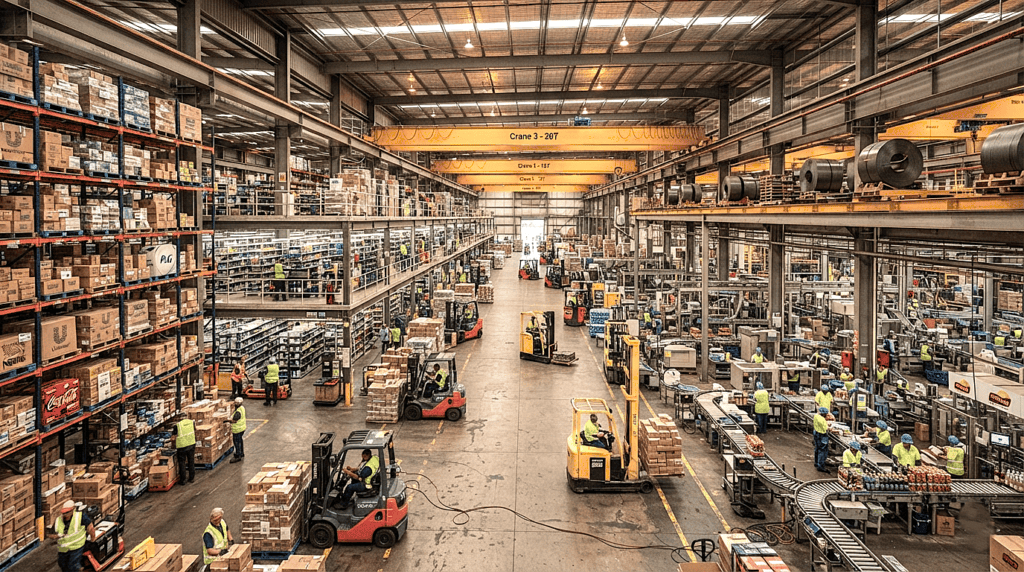
1: Logistics and distribution hubs — Clear-span warehouse shed construction designed for heavy truck dock integration and inventory racking.
2: Cold chain logistics — temperature-controlled warehouses for import/export goods, perishable food, and pharmaceutical distribution serving Twin Cities and northern Pakistan
3: Pharmaceutical manufacturing and storage — GDP-compliant cold storage and production facilities for Islamabad and Rawalpindi’s pharmaceutical sector
4: Food processing and packaging — HACCP-compliant production floors and cold storage for food manufacturers and exporters
5: Factory sheds for light engineering, electronics assembly, and textiles — Hattar Industrial Estate and Rawalpindi’s industrial corridors
6: Government infrastructure projects — warehousing, storage, and facility structures subject to CDA and federal authority documentation requirements
7: Medical supply and hospital stores — regulated temperature-controlled storage for medical consumables and biologics
8: E-commerce fulfillment centres — clear-span warehouses with mezzanine picking floors and integrated racking provisions
Frequently Asked Questions — Warehouse Sheds and Cold Storage in Islamabad and Rawalpindi
What documentation is required for a warehouse shed or PEB structure in Islamabad or Rawalpindi?
All permanent structures in Islamabad require CDA approval, which includes stamped structural drawings from a PEC-registered engineer, a structural calculation report, material specifications, and completion of the relevant NOC application. Rawalpindi structures require equivalent documentation submitted to the Rawalpindi Development Authority (RDA). For cantonment-area projects in Rawalpindi, cantonment board documentation requirements apply. Steel City provides all required engineering documentation as part of every Twin Cities project package and manages the CDA and RDA submission process on the client’s behalf, using the team’s existing project experience with both authorities to avoid delays.
What panel thickness is correct for a cold storage shed in Islamabad in 2026?
The correct PUF panel thickness depends on the required interior temperature range. For ambient cool storage maintaining +5°C to +15°C, 100mm PUF panels are standard. For chilled food storage maintaining 0°C to +5°C, 100 to 120mm panels are specified. Frozen storage from 0°C to -18°C requires 150mm panels, and deep-freeze cold rooms at -18°C to -40°C also require 150mm panels. Islamabad’s colder winter ambient temperatures compared to Punjab cities mean that the refrigeration system benefits more in winter than a Lahore installation at the same specification, but engineers must still calculate the panel spec for the summer peak ambient condition. Steel City’s cold storage engineering team performs a full thermal calculation for every project before specifying panel thickness — not basing the decision on upfront cost.
How long does warehouse shed construction in Rawat or Hattar take?
A standard warehouse shed in Rawat Industrial Estate or Hattar Industrial Estate takes 4 to 7 weeks from order confirmation to site handover for single-span structures up to 3,000 sqm. This timeline runs in parallel with site foundation work — Steel City’s fabrication at the Lahore facility proceeds at the same time as foundation casting at the project site, ensuring the project loses no time between fabrication completion and structural erection. Multi-bay or large-format warehouse complexes above 5,000 sqm take 8 to 12 weeks. CDA or RDA approval, where required, runs in parallel with fabrication and is initiated immediately after design sign-off to avoid programme delays.
What is the difference between PUF and PIR panels for pharmaceutical cold storage?
PUF (Polyurethane Foam) panels are the standard cold storage insulation in Pakistan, offering excellent thermal performance — typically 0.022 to 0.028 W/mK thermal conductivity — at a competitive cost. However, standard PUF panels are combustible and do not satisfy fire safety requirements for pharmaceutical manufacturing or food processing environments where regulations or insurers require fire-rated building materials. PIR (Polyisocyanurate) panels deliver equivalent thermal performance with significantly better fire resistance — PIR panels are self-extinguishing and generate lower toxic smoke on combustion than PUF. Steel City specifies PIR panels for pharmaceutical cold storage sheds and food processing facilities in Islamabad and Rawalpindi, and PUF panels for general cold chain logistics and food distribution storage where regulations do not mandate fire-rated materials.
How does Islamabad’s climate affect cold storage shed running costs compared to Lahore?
Islamabad’s colder winters are an advantage for cold storage operations — refrigeration systems work less hard during the winter months compared to a Lahore installation at the same specification, reducing electricity consumption and compressor wear during the October to March period. However, Islamabad’s summer temperatures, while lower than Lahore’s peak, still reach 38°C to 40°C in June and July, so engineers must calculate summer refrigeration loads for the same worst-case ambient conditions as any other Pakistani city.
Islamabad’s climate modestly lowers cold storage operating costs compared to Lahore across the full annual cycle, provided engineers correctly specify the building envelope insulation for the summer peak ambient condition.
Can Steel City supply and install cold storage steel sheds in Hattar or remote KPK locations?
Yes. Steel City delivers and installs warehouse sheds, PEB structures, and cold storage facilities at Hattar Industrial Estate and other accessible KPK locations.
Specifically, Steel City fabricates all structural components at its Lahore facility and transports them directly to the site on flatbed trailers. Dedicated installation teams then deploy to KPK project sites with all necessary equipment for rapid structural erection. Furthermore, for cold storage facilities, Steel City coordinates directly with the client’s refrigeration contractor to install and commission HVAC systems once panel installation concludes. To ensure complete transparency, the master schedule accounts for the additional transport leg from Islamabad right from the outset.
Why Choose Steel City for Your Twin Cities Warehouse Shed or Cold Storage Project?
Steel City has delivered warehouse sheds, PEB structures, and cold storage facilities across Islamabad, Rawalpindi, Rawat Industrial Estate, and Hattar. Every project benefits from the same engineering capability — in-house structural design, CNC fabrication, and on-site installation — but adapts to the specific documentation requirements, climate demands, and industry standards of the Twin Cities market.
Our engineering team designs every project — whether a standard warehouse shed in Rawat or a pharmaceutical cold storage steel shed in Islamabad — to the specific thermal, structural, and regulatory requirements of the project’s location and use. As a standard, all Twin Cities projects include full CDA- or RDA-compliant documentation, PEC-stamped engineering drawings, material test certificates, and a structural warranty. Furthermore, cold storage projects include commissioning documentation appropriate to the client’s regulatory framework.
Get Your Quote for Rawat, Rawalpindi, or Islamabad
Ready to plan a warehouse shed in Rawat, a PEB factory in Rawalpindi, or a cold storage steel shed in Islamabad? Contact Steel City’s engineering team via WhatsApp or phone. Share your requirements — shed type, floor area, required temperature range for cold storage, location, and timeline — and we will prepare a detailed, fixed-price proposal with all CDA and RDA documentation included within 24 hours.
Whether building a 1,000 sqm logistics warehouse in Rawat Industrial Estate or a GDP-compliant pharmaceutical cold store in Islamabad’s I-9 sector, Steel City leverages proven engineering expertise to deliver to Twin Cities standards — on time, on budget, and fully documented.
Build Smarter with Steel City.