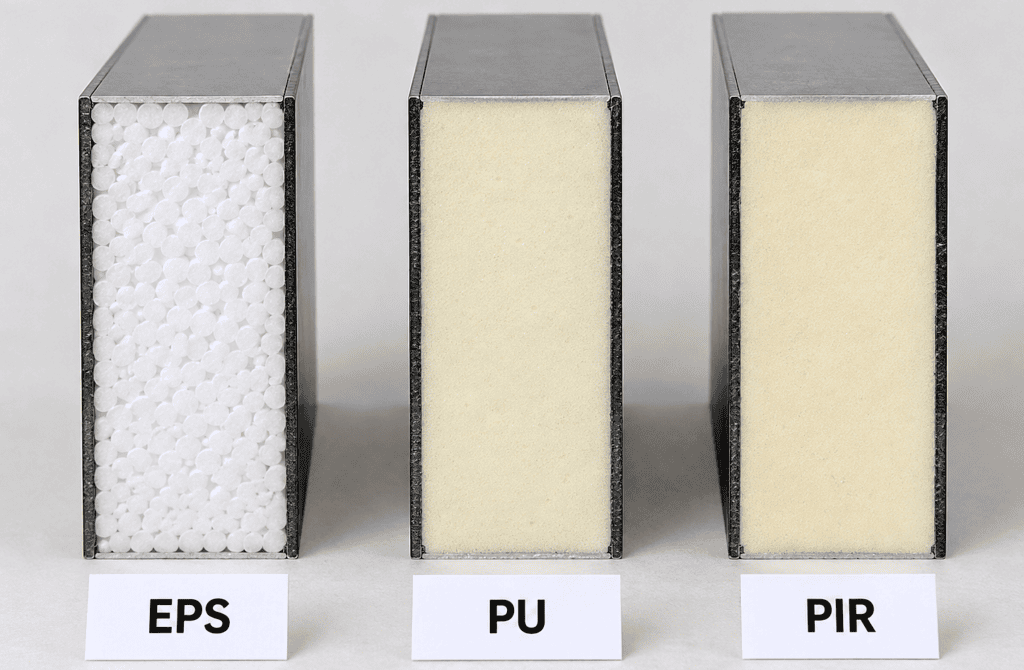
Choose the core by fire risk and occupancy first, cooling load second and price last. EPS is the lowest-cost core, but it needs more thickness for the same insulation and has the lowest heat and fire tolerance of the three. PU insulates better per millimetre for a moderate premium. PIR insulates marginally better again and generally behaves better in fire than PU, usually at the highest price. This guide compares EPS vs PU vs PIR sandwich panels as porta cabin insulation panels for site offices. It also covers the steel skins and the documents to request before you order.
EPS vs PU vs PIR sandwich panels: core properties at a glance
The figures below are typical published ranges, not guarantees. Your supplier’s declared values and test reports govern.
| Property | EPS | PU | PIR |
|---|---|---|---|
| Core conductivity, λ (W/m·K) | 0.036–0.040 | 0.022–0.028 | 0.020–0.024 |
| Core density (kg/m³) | 14–20 | 38–45 | 38–45 |
| Behaviour in fire | Softens, melts and can drip | Burns readily; less stable char | Burns; more stable char than PU |
| Water uptake if wetted | Higher | Low (closed-cell) | Low (closed-cell) |
| Typical relative cost | Lowest | Middle | Highest |
PU vs EPS panels differ most in conductivity: for the same insulation, PU typically needs about two-thirds of the EPS thickness, depending on declared values. PU and PIR sit close together thermally. What separates them is fire behaviour and price.
Sandwich panel thermal performance: how much thickness do you need?
Thermal resistance is thickness divided by conductivity. Add surface resistances and you have an indicative U-value in W/m²·K, where lower is better. The table below assumes λ of 0.038 for EPS, 0.024 for PU and 0.022 for PIR, plus 0.17 m²·K/W for surface resistances. It ignores joints, fixings and the frame, so real panels perform slightly worse. These are calculated figures, not test results.
| Panel thickness | EPS (λ 0.038) | PU (λ 0.024) | PIR (λ 0.022) |
|---|---|---|---|
| 50 mm | 0.67 | 0.44 | 0.41 |
| 75 mm | 0.47 | 0.30 | 0.28 |
| 100 mm | 0.36 | 0.23 | 0.21 |
A 75 mm EPS panel performs close to a 50 mm PU panel. To match 50 mm of PIR, EPS needs about 85 mm. Thicker EPS closes much of the gap, at the cost of wall depth, transport volume and more combustible material.
For site office insulation in Pakistan, the problem is mostly heat gain. The roof usually takes the greatest solar load, so put extra thickness or a better core there before the walls. Doors, windows and air leaks can undo good panels: specify sealed joints, insulated doors and shaded glazing.
Fire behaviour: the trade-off that decides occupied cabins
EPS is a thermoplastic. It softens and melts at relatively low temperatures, which can open the panel and expose the interior. Cross-linked structures prevent PU and PIR foams from melting and running in the same way, but the materials still burn: PU more readily, PIR with a more stable char. None of the three is non-combustible.
Classification belongs to the complete panel, not the core family. Published classifications for PU and PIR panels run from F to B-s1,d0, depending on formulation, facings and joints, and “fire-retardant” is not a classification. Ask for the EN 13501-1 report for the exact panel, or the large-scale test your client or insurer specifies.
Ignition sources are typically electrical faults, generators, heaters and nearby hot work, not the panel itself. Use a competent electrician, protect cable entries, keep heat sources off panel faces and seal any cut that exposes the core. If people sleep in the cabin, cabins are stacked or the client sets a fire specification, move to a tested PIR panel or to mineral wool (rockwool). The Building Code of Pakistan Fire Safety Provisions (2016) is the national reference; its application to temporary cabins depends on the authority, the client’s HSE rules and occupancy, so ask your consultant.
Strength, handling and heat
PU and PIR cores are generally stiffer and stronger in shear than EPS and bond to the steel skins as they cure. EPS panels rely on an adhesive bond, so ask how the manufacturer tests it and check for delamination and crushed edges on delivery.
Heat is the other limit. EPS tolerates the least heat of the three; EPS datasheets commonly quote a long-term limit of about 70–80°C. Dark steel skins in strong sun get very hot, so use lighter roof colours and ask for the maximum service temperature of the core and adhesive.
Check the steel skins as well as the core
The skins carry most of the bending load and decide how long a cabin lasts outdoors. State the grade by minimum yield strength, not tensile strength alone, with base metal thickness and its permitted negative tolerance, coating mass and paint system. Relevant substrate standards include ASTM A653/A653M (galvanised), ASTM A792/A792M (aluminium-zinc coated) and EN 10346, with ASTM A755/A755M or EN 10169 for coil-coated steel. Coastal sites such as Karachi justify a heavier coating class and sealed cut edges.
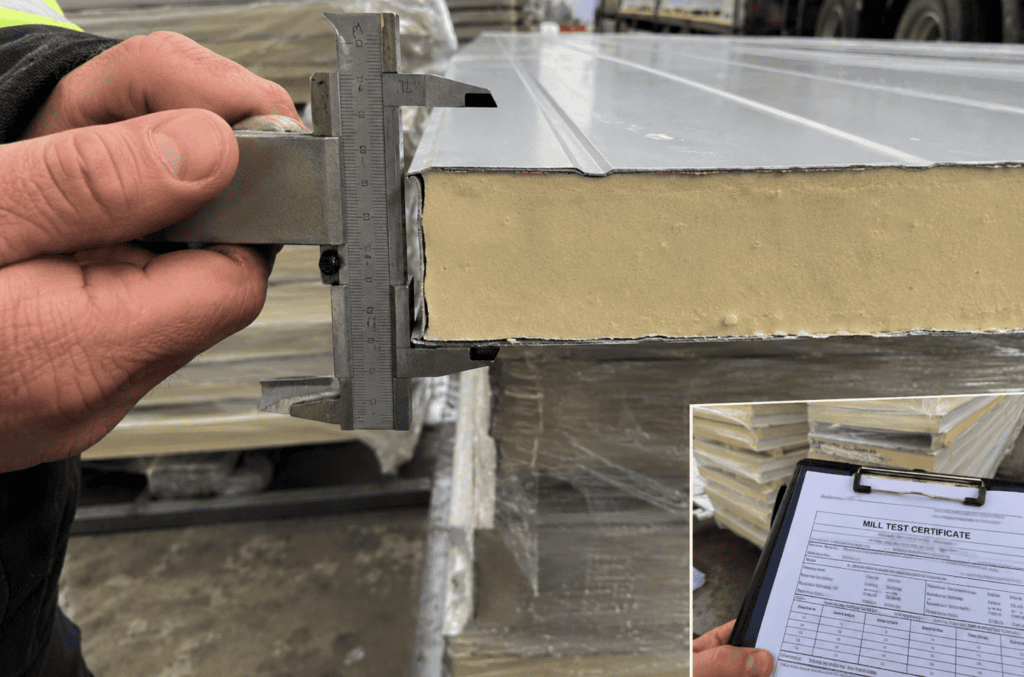
The mill test certificate should link the skin steel to a heat or coil number and report ladle chemistry, mechanical properties and coating mass.
Which core suits which site office?
Match the core to how the porta cabin will be used.
- EPS: short-duration sites, lightly occupied offices and tight budgets.
- PU: longer-duration offices in hot zones, where thickness is limited or air-conditioning running cost matters.
- PIR: overnight occupancy, stacked cabins, hot work or fuel nearby, or clients who require fire test evidence. Confirm availability and the test report first.
- Mineral wool: where a non-combustible core or a fire-resistance rating is required.
In colder northern sites the same ranking applies in reverse: lower conductivity cuts heating cost. The Building Code of Pakistan Energy Provisions covers larger buildings and building clusters rather than a single cabin, so ask whether a large camp triggers it.
Insulated cabin specification: what to ask for before you order
Use this checklist when comparing quotations.
- Core named in writing as EPS, PU or PIR, not just “PUF”.
- Core density in kg/m³ and declared thermal conductivity, with test method, report date and the product standard (for example EN 14509).
- Fire classification report for the complete panel, not a brochure claim.
- Actual wall and roof panel thickness, with tolerance.
- Skin grade, base metal thickness, coating mass, paint system and coil mill certificate.
- Joint, sealant and fixing details, including how cut edges are sealed.
- On delivery, measure panel and skin thickness with callipers at a cut edge, allowing for paint and zinc, and inspect for dents, crushed edges, delamination and wet cores.
- Store panels flat, off the ground and covered.
- Inspect an offcut: PU and PIR should be uniform without voids or poorly bonded areas; EPS beads should be fused, not crumbling.
These site checks are preliminary. For overnight, stacked, or fire-specified cabins, commission independent testing at an accredited laboratory (such as PCSIR or UET) that possesses the equipment for specific tests, such as thermal conductivity or reaction to fire. Prepare the base and delivery route before dispatch using this porta cabin site preparation checklist.
Frequently asked questions
What does “PUF” mean in a quotation?
PUF usually stands for polyurethane foam. Because the term is sometimes used loosely for both PU and PIR, ask which core is supplied and request density and test reports.
Will a better core remove the need for air conditioning?
No. Insulation slows heat gain, but people, equipment, glazing and air leaks still add heat. In Pakistan’s hot plains, plan for air conditioning and use insulation to reduce its size and running cost.
Can sandwich panel cabins be relocated?
Yes, but each move risks edge damage, fixing wear and sealant failure. Lift by the frame’s lifting points, not the panels, and inspect and reseal joints before reinstalling.
Is a thicker panel always worth paying for?
Returns diminish. In the table above, moving EPS from 50 mm to 75 mm cuts the U-value by 0.20, but 75 mm to 100 mm by only 0.11. Check glazing and air leakage before paying for more thickness.
Conclusion: choosing a core for your site office
The best answer on EPS vs PU vs PIR sandwich panels is rarely the cheapest or the most expensive core. It is the core whose trade-offs your site can manage: EPS where occupancy and fire risk are low, PU where cooling load and thickness dominate, PIR where fire evidence matters. Whichever you choose, buy against test documents rather than product descriptions.
To request a quotation, send Steel City’s engineers the cabin size and number of units; the core you are considering (EPS, PU or PIR) and panel thickness for walls and roof; the skin steel specification; any fire or insulation documents your client requires; the delivery city and site access; and your required delivery date. They will confirm which core types can be supplied for your project.